Iran Conflict — 2026-06-13 (AM)


Current status
Reuters exclusive: UAE agreed to unlock billions of dollars in frozen Iranian funds as part of the US ceasefire package — Abu Dhabi issued a categorical denial within hours. Reuters, citing two sources familiar with the arrangement, reported on Friday evening that the UAE had agreed to release billions of dollars in frozen Iranian funds as part of the US-brokered ceasefire package; the figure most cited in regional press summaries is a $3 billion immediate tranche with another $10 billion to follow, and one Iranian outlet reported a Boeing aircraft carrying $3 billion had been seen over Tehran. The UAE Ministry of Foreign Affairs responded the same day with a categorical denial, calling the reports “entirely false and unfounded,” saying no frozen Iranian funds have been released, transferred, or facilitated through the UAE, and calling on media to “exercise accuracy, rely on official sources, and refrain from publishing or circulating unverified information.” The denial was carried by WAM (state news agency) via Emirates247 and was the lead item on the Arabian Business and Al Arabiya English wire. The Reuters story has not been retracted; the contradiction is unresolved at the AM cutoff.
Pakistani PM Sharif: a ‘final, agreed-upon text’ of a US-Iran ceasefire has been reached; Iran’s foreign minister says the deal has ’never been closer.’ Pakistani Prime Minister Shehbaz Sharif said Friday that a “final, agreed-upon text” of a US-Iran peace deal has been reached — a notable escalation of Pakistan’s role as the public mediator of record and the first time a head of government has put the word “final” on the record. Iran’s foreign minister, in a statement carried by Al Jazeera, said the ceasefire deal with the US has “never been closer” but cautioned against media reports on the terms of the possible agreement. The “final text” framing matters because it forces Iran’s foreign ministry into one of two public postures: confirming the text is done (and committing Tehran to it), or publicly walking back the Pakistani PM. The official Iranian read so far is the more cautious one.
Trump fires back at the IRNA-leaked draft: the ceasefire terms leaked overnight are ‘fake,’ their leakers are ‘dishonorable people.’ The day after the IRNA-leaked draft terms — Hormuz control via an Iran-Oman partnership, Lebanon in the deal scope, nuclear punted 60 days, missile program off the table — were read out across the regional press, Trump publicly disputed the text. The Washington Post, Reuters wire and Al Jazeera’s main line all reported that Trump called the leaked terms “fake” and decried “dishonorable people,” an unusually personal escalation of the public framing war between the two negotiating teams. A senior Trump administration official told CNBC a deal could be signed “in the coming days” but that it was not “100% certain.” The NYT reported separately that the two sides are “not quite at the finish line yet” — a more cautious read of the same Pakistani-led “final text” claim. The mismatch between Sharif’s “final” and Trump’s “fake” is the single most important open question in the deal narrative this morning.
Iran’s ’no timeline yet’ and ’no compromise on red lines’ is the operative Tehran read of the deal narrative. Iranian state media carried a foreign-ministry statement saying there was “no timeline yet” for signing a US deal, that Iran’s red lines would not be compromised, and that the president and the foreign minister would speak on the substance before any text is locked. Al Jazeera’s live blog added that the draft text under discussion was “a memorandum of understanding” — a status one rung below a formal ceasefire agreement, consistent with the Iranian position that the deal is real in concept but conditional in detail. The 60-day post-signing nuclear track that the IRNA leak had set as a follow-on is the single most important variable in the Iranian read: Tehran wants the nuclear file off the immediate signature without surrendering the right to enrich on a defined timeline.
Lebanon continues to take strikes, in open contradiction to the deal narrative: Israeli airstrikes hit Tyre on Friday and hospitals are coming under fire. The New York Times reported that Israeli strikes on Friday left Lebanon “out of sync with a cautious optimism taking hold elsewhere in the Middle East.” UN News, in a separate dispatch, said the humanitarian situation in Lebanon is being pushed further into crisis as essential services and healthcare are targeted, with multiple hospitals impacted in the latest wave. The Lebanon kinetic cycle is the most visible contradiction in the deal-narrative frame: the IRNA-leaked draft explicitly rolls Lebanon into any permanent end to the fighting, but Israel’s stated military posture in Lebanon is independent of the US-Iran track and has not changed. Until the Lebanon file is named in a signed text, the strikes are expected to continue.
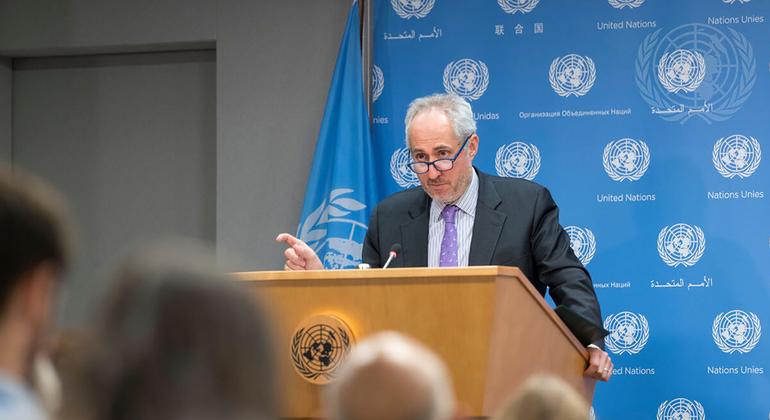
UN ’encouraged’ but watching: spokesman says conflicting reports on Friday make the deal status ambiguous, but the UN supports any cessation of hostilities. The UN Spokesperson for the Secretary-General said in New York that the UN is “encouraged” by talk of a possible US-Iran ceasefire deal, continues to monitor developments, and noted the conflicting reports on Friday about the deal’s status. The UN framing is procedurally supportive but cautious: it stops short of endorsing either the Pakistani “final text” or the Trump “fake” framing, and reads as a deliberate non-intervention into a US-mediated diplomatic track that does not yet have a signed text.
Al Jazeera Inside Story: ‘Will there be a deal to end the Iran war this time?’ — a Gulf-collective-security view from the deal’s downstream effects. Al Jazeera’s Inside Story feature, and a separate Al Jazeera analysis piece, framed the post-deal picture as a Gulf-collective-security question: if the US-Iran ceasefire holds, the Gulf monarchies are likely to use the post-war window to revisit their security arrangements, including the question of how the Iran threat is integrated into a wider US-GCC defense framework. The piece noted that an Iran-US deal could provide an opportunity for the Gulf states to review their security arrangements — an explicit UAE-relevant read, given Al Dhafra and the Joint Air Defense partnership. The framing assumes the deal holds; if it collapses, the Gulf-collective-security review falls with it.
UAE / Gulf angle
The UAE’s categorical denial of the $3B / $10B funds story is the operative UAE government read of the Reuters report — and the Reuters story has not been retracted. Reuters wire carried the “UAE to unlock billions of dollars for Iran, sources say” story; regional wires (Middle East Eye, i24NEWS, Internazionale, Iran International) carried the same line with the $3B / $10B figures and added a Boeing-aircraft-over-Tehran flourish. The UAE MoFA’s categorical denial, issued through WAM and carried across the regional press, is the strongest possible UAE read short of a legal threat: it denies the $3 billion figure specifically, denies the transfer itself, and calls the reports “entirely false and unfounded.” A US Congressman quoted on the Al Jazeera video wire said Trump “won’t send loads of money to Iran”; Vice President Vance, per a separate Voice of Emirates wire, denied the funding allegations. The factual record at the AM cutoff is: Reuters says yes, UAE says no, Vance says no, US Congress says no. The post will not write a definitive verdict; it will note the contradiction.
If the Reuters story is true, the UAE is the under-the-radar financial engine of the deal — and the structural Gulf-shift operator. The IRNA-leaked draft (Day 105 PM) front-loaded a partial release of frozen Iranian assets on signing, with the remainder released gradually during the 60-day nuclear follow-on track. The Reuters story, if confirmed, puts the UAE in the position of being the principal Gulf channel for the funds release, alongside the technical arrangement with Oman on Hormuz governance. For the UAE, that role is structurally different from being a passive recipient of a US security umbrella: it is the Gulf state that converted wartime exposure into a financial-and-diplomatic intermediation role. The UAE MoFA’s denial does not contradict the structural role; it only disputes the Reuters narrative of how the deal was implemented.
Pakistan has emerged as the public mediator of record — and the UAE-as-financial-channel is the GCC counterpart. The two roles now form a single deal architecture. Trump’s Day 105 PM account credited Pakistan with the late-Thursday “we have a deal” call that triggered the strike cancellation; Day 106 AM has Pakistani PM Sharif declaring a “final, agreed-upon text” of the deal. The structural counterpart on the Gulf side is the UAE-as-funds-channel role that the Reuters story describes. Pakistan brings the diplomatic mediation; the UAE brings the financial channel; Oman brings the Hormuz-governance mechanism; Qatar and Saudi Arabia are notably absent from the public record of the deal architecture. The Gulf side of the deal is, in effect, a two-state arrangement (UAE + Oman) with Pakistan mediating from outside the GCC. The political cost to the UAE of that role — particularly if it is denied and then quietly confirmed — is the single most under-reported UAE-relevant variable in the deal.
Gulf collective security after the war is the next-decade question, and the UAE’s role in it is now both more central and more contested. Al Jazeera’s Gulf-security-after-the-war analysis makes the case that a US-Iran deal, if it holds, gives the GCC a window to review the security architecture that has held for the duration of the war. The UAE’s role in that review is now larger than it was at the start of the war: it is the principal Gulf financial channel for the deal, the host of Al Dhafra and the Joint Air Defense partnership, the operator of the Habshan-Fujairah bypass pipeline that proved its strategic value in the Hormuz-closure phase, and the Gulf state that has the most to lose from a Lebanon-track kinetic relapse. The Al Jazeera Inside Story framing is the most coherent public read of where the UAE sits in the post-deal picture; the political cost of the Reuters story, if confirmed, is that the UAE’s role is now a public question rather than a quiet one.
What changed since the previous update (2026-06-12 ~14:30 UTC / Day 105 PM)
From “Iran keeps Hormuz control via Iran-Oman bilateral” (Day 105 PM) to “UAE allegedly paid Iran $3B and agreed to release $10B more” (Day 106 AM). The Day 105 PM picture was the IRNA-leaked draft: Iran gets a bilateral Hormuz arrangement with Oman, nuclear is punted 60 days, missiles are off the table, Lebanon is in. The Day 106 AM picture adds the missing Gulf-side of the deal: the Reuters report that the UAE is the financial channel for the funds release — and the UAE MoFA’s categorical denial of the same. The two stories together imply that the deal architecture is a four-party arrangement (US, Iran, Pakistan, UAE) with Oman providing the Hormuz mechanism and Qatar/Saudi Arabia visibly absent. The UAE is now structurally central to the deal in a way it was not in the Day 105 PM IRNA-leak framing.
From “Iran’s supreme leader signed off” / “Trump ‘maybe over the weekend, in Europe’” (Day 105 PM) to “final, agreed-upon text reached” / “deal has never been closer” / Trump calls leaked terms “fake” (Day 106 AM). The Day 105 PM frame was a Trump-led victory lap with a vague weekend signing in Europe and an Iranian “nothing has been finalized” response. The Day 106 AM frame is sharper: Pakistani PM Sharif on the record with “final, agreed-upon text,” Iran’s foreign minister with “never been closer,” and Trump escalating the framing war by calling the leaked terms “fake” and the leakers “dishonorable.” The contradiction between Trump’s “fake” and Sharif’s “final” is the most important new fact since the PM run, and the most likely trigger of a weekend market reversal if the text is not produced.
The Hormuz chokepoint question has moved from “Irán keeps control via Oman” to “the deal text does not yet name a Hormuz control mechanism” (Day 106 AM). The IRNA-leaked draft had named the Iran-Oman partnership as the operative mechanism; the Day 106 AM deal-narrative reporting, including the BBC line and the Al-Monitor draft-text coverage, has moved to “the deal would lead to Hormuz reopening” without yet naming the control mechanism. The shift from a named mechanism to an un-named reopening is consistent with Pakistan’s “final text” claim — the mechanism may have been negotiated out of the public-facing text and into a separate implementation track.
The UAE is the single biggest new variable in the deal narrative. The UAE was not a named actor in the Day 105 PM IRNA-leaked text beyond the Hormuz implications of an Iran-Oman bilateral that cuts the GCC out of the chokepoint deal. The Day 106 AM Reuters story makes the UAE the financial channel for the funds release, and the UAE MoFA’s categorical denial makes the UAE the strongest possible public denier of the same. The UAE has gone from being a downstream beneficiary/victim of the deal to being an active, contested, named actor in the deal architecture. The political implications for the UAE are not yet visible; the public-record implications are.
Lebanon has gone from “in the deal scope” (Day 105 PM) to “still under Israeli strikes, hospitals hit” (Day 106 AM). The Day 105 PM IRNA-leaked text named Lebanon as in-scope; the Day 106 AM frame is that Israeli strikes on Tyre on Friday and continued hits on Lebanese hospitals put the deal narrative in open contradiction with the Lebanon ground reality. The IRNA-leak’s Lebanon inclusion now reads as an aspirational Iranian negotiating position, not a settled bilateral fact, until a signed text names a Lebanon ceasefire mechanism.
Latest headlines