Tech News Roundup — July 5, 2026 (PM)
The afternoon roundup leans Microsoft-heavy: Windows 11’s next annual update gets its first proper deep-dive, ASUS puts Qualcomm’s Snapdragon X2 Elite up against Apple’s M5 and Intel’s Panther Lake, and the Xbox business under new CEO Asha Sharma faces a brutal stretch of studio-sale rumors, console-price reality checks, and a “Helix” hardware rethink. Phoronix delivers three kernel stories, ReactOS hits a Half-Life 2 milestone, and Pplware files a sobering lead on Linux security alongside five shorter Portuguese-language items.
Microsoft
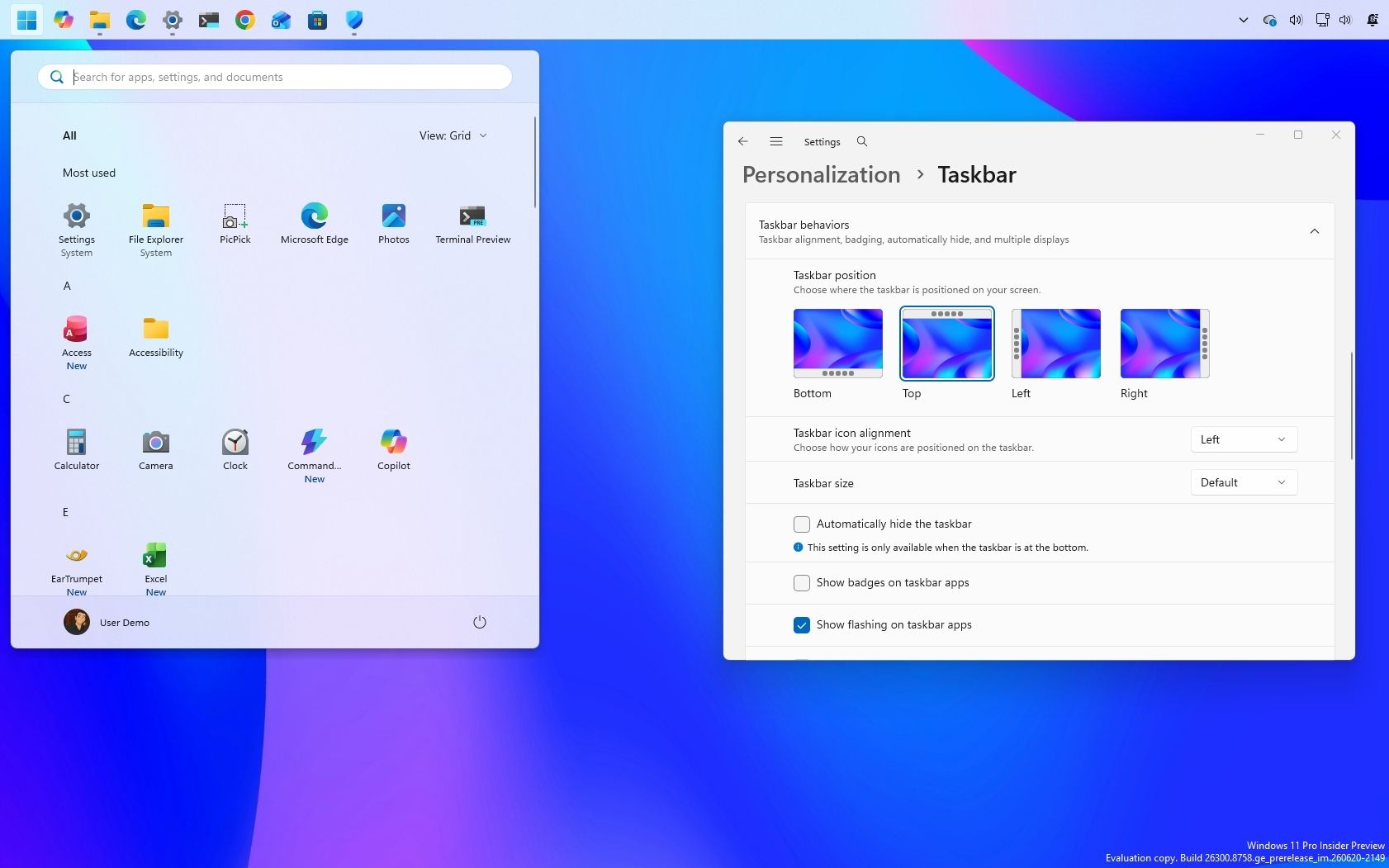
Windows 11 version 26H2 is shaping up as a quieter but practical update — seven features worth knowing. Microsoft will roll out 26H2 in the second half of 2026 as a small enablement package that switches Windows 11 25H2 forward to the new version number, but the actual feature payload has been arriving all year through cumulative updates. Windows Central highlights seven of the most useful additions: (1) Ask Copilot, an optional AI search box that lives next to Windows Search and can find files, apps, and settings alongside chat-style answers; (2) a more customizable Taskbar that can now be positioned anywhere on screen and resized smaller; (3) a redesigned Start menu with small/large size options, the ability to independently show/hide Pinned, Recent, and All, and a renamed “Recent” section replacing the old “Recommended”; (4) a long-requested toggle to turn off web results in Windows Search (and separately the Microsoft Store app suggestions); (5) more Windows Update controls, including a calendar-based “pause for up to 35 days” option that can be used repeatedly, plus a single monthly reboot instead of separate driver/product/firmware cycles; (6) Administrator Protection, a new Windows Security feature that creates a temporary account for elevated tasks and uses Windows Hello, replacing the long-standing User Account Control; and (7) a modernized Run dialog with rounded corners, a recent-commands list, and an opt-in toggle to keep the classic version. All seven are currently in the Windows Insider Experimental channel and could still change before release. [Windows Central]
The week’s biggest hardware story: Sony kills PlayStation discs, Sony revokes purchased movies, Microsoft retires the Surface Go and Surface Laptop Go. Windows Central’s weekly roundup also covers the leaked “Positron” disc-to-digital program for Xbox — insert a disc once to permanently claim a digital license tied to your Microsoft account, only lost if the disc is registered elsewhere — and a leaked “Copilot OS” video that was never intended for consumers. The Surface Go and Surface Laptop Go have both reached end-of-life, and Windows 10 picked up an extra year of security updates. [Windows Central]
Hardware
- ASUS Zenbook A14 (2026) review: Snapdragon X2 Elite tops Apple M5 in burst CPU and stretches battery to 17 real-world hours. The 2026 revision swaps in Qualcomm’s Snapdragon X2 Elite (X2E-88-100), pairing it with the same 70Wh battery as last year and the same chassis — dual USB4 Type-C, HDMI 2.1, 3.5 mm audio on the left, and a single full-size USB-A 3.2 Gen 2 on the right (a real USB-A in 2026 is worth calling out). In benchmarks the new A14 outperforms the 14-inch MacBook Pro’s M5 in Geekbench 6 single-core burst, edges past the Lenovo Yoga Slim 7x with the same SoC, and even outpaces Intel Panther Lake in the Surface Laptop 8 for Business. Sustained load (Cinebench 2024) shows the same generational lead over the 2025 A14 and the original Snapdragon X. Battery is the standout: ASUS claims “over 33 hours” of video playback, the reviewer hit 23 hours 38 minutes in PCMark 10’s video test, and a real-world Windows Battery Report after a week of use logged 17 hours. The 14-inch OLED panel hits 407 nits full-screen (600 nits peak in zones) with 100% sRGB/P3 and 94% Adobe RGB — strong for creators. The Snapdragon NPU is rated at 80 TOPS, useful mainly for Microsoft’s Click To Do and a handful of other Copilot+ features; ASUS preloads a couple of Adobe/Dropbox ad pins on the Start menu that are easily removed. Windows on ARM software compatibility is still the soft caveat — old printer drivers are the realistic risk. [Windows Central]
Gaming
Xbox’s business under Asha Sharma: studio-sale rumors, “Ramageddon” hardware losses, and a next-gen rethink. The latest Windows Central Podcast with Jez Corden and Zac Bowden takes the temperature a month into Sharma’s tenure. The picture: heavy rumors that Microsoft is looking to sell or close certain first-party studios (Ninja Theory and Undead Labs named), a console-price hike already on shelves, and a major rethink of what the next-generation “Helix” console looks like. Microsoft-wide headcount reductions are being driven by AI infrastructure spending across Azure, Surface, and Xbox. The hosts explain “Ramageddon” — skyrocketing RAM and component prices mean Microsoft and Sony are losing hundreds of dollars per console, a model that worked when hardware was subsidized by software sales but breaks down when players buy the hardware and spend their money on Steam instead. Sony’s shift away from physical disc drives is forcing a parallel rethink: the next Xbox might ship without a disc drive but support a leaked disc-to-digital platform feature called “Positron” (insert a disc once, claim a permanent digital license tied to your Microsoft account). Predictions for PlayStation 6 and Xbox Helix include $1,000+ price tags and a longer cross-gen lifespan for the Series X/S, with the latter potentially grandfathered as budget tiers alongside the premium Helix. [Windows Central]
The Verge says it plainly: Xbox is a disaster. Andrew Webster’s weekly Stepback newsletter argues that the Xbox brand has hit a wall in the months since its June showcase: hardware selling at a loss, studios reportedly on the chopping block, and a leadership transition that has not stabilized the narrative. The showcase itself looked strong (Halo, Gears of War, Fable, a translucent Xbox, plus Persona and Crazy Taxi surprises), but the post-showcase reality has been a steady stream of bad headlines. [The Verge]
Linux & Open Source
ReactOS now runs Half-Life 2 — one month after booting the original Half-Life. Michael Larabel notes that the open-source “Windows-compatible” ReactOS project has hit another milestone: Half-Life 2 is now playable, less than 30 days after the original Half-Life was demonstrated running on the OS. [Phoronix]
AMD begins staging graphics driver changes for Linux 7.3. In parallel with Intel’s Linux 7.3 volley, AMD has started sending pull requests of “new stuff” to DRM-Next for the upcoming kernel cycle. [Phoronix]
Intel prepares Linux for IPU8 web camera support on Nova Lake laptops. More kernel patches confirm that next-gen, high-end Nova Lake laptops will ship with IPU8 image-processing capabilities — relevant for any Linux distribution shipping on Intel’s premium mobile silicon in 2026/2027. [Phoronix]
“O mito caiu”: Linux faces an unprecedented security crisis. Pplware runs a long read arguing that the Linux ecosystem is going through a critical period for security. The long-held belief that the OS was effectively immune to viruses and malware is no longer tenable — a succession of recent incidents is forcing a re-evaluation. [Pplware]
In Brief
- Vizio’s 65-inch Mini LED Quantum TV quietly becomes the best “dumb” TV on the market at $398. Quantum-dot picture quality at a budget price is the headline; the bigger story is that Vizio OS is good enough that you can simply not use it. [The Verge]
- Wildfire smoke contains dangerous PM2.5 fine particles — Portugal faces elevated rural fire risk every summer. Beyond the destruction of forest and housing, Pplware highlights the often-invisible hazard of air-quality degradation. [Pplware]
- A photography student launched a camera to the stratosphere to “photograph” the energy of the universe. The HELIOS project is described as the first photographic work created directly by cosmic radiation, captured on analog film. [Pplware]
- Cybersecurity: an explainer on hacking and penetration testing. Pplware walks through the legitimate side of hacking — finding vulnerabilities and hardening systems, not the criminal stereotype. [Pplware]
- What the AC recirculation button actually does inside your car. A short Pplware explainer on the small climate-control button many drivers press without knowing exactly what it does. [Pplware]
- Google is testing a new reCAPTCHA that uses hand gestures captured by the camera to block bots. An experimental validation approach that adds a new barrier against automated abuse. [Pplware]
Roundup compiled from the TTRSS Tech feed. 15 articles from 5 sources summarized.