
Tech News Roundup — July 19, 2026 (AM)
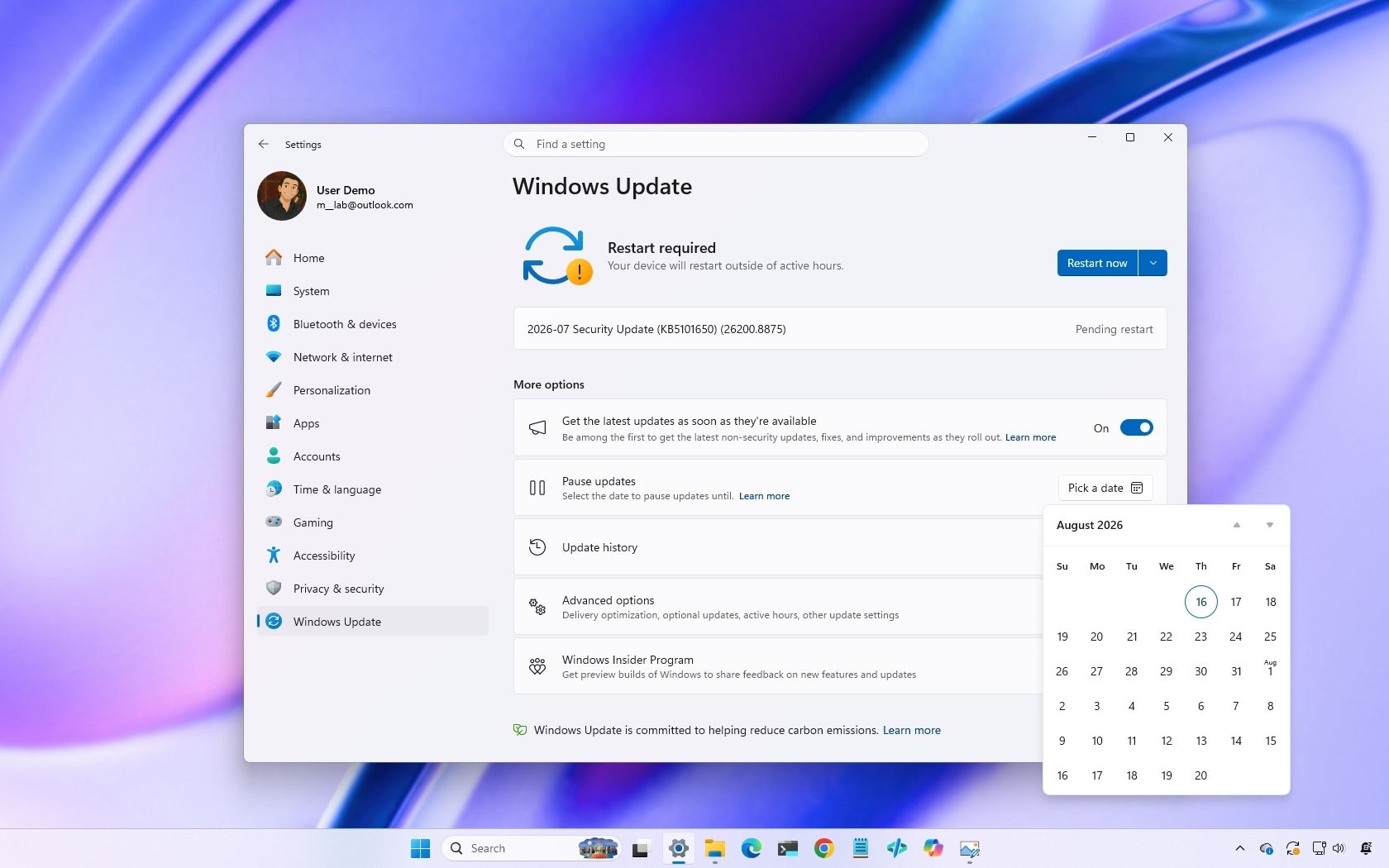
Microsoft pushed one of the largest Patch Tuesday drops on record this month, Apple’s fight with OpenAI is now sending legal letters to individual ex-employees, and the ESET threat report shows geopolitical tensions driving a fresh wave of cyber-espionage. Linux got its usual Phoronix love — GNU Hurd is inching forward with AArch64 and Rust, and Mesa 26.2 narrows the NVK gap to NVIDIA’s proprietary driver.
Microsoft / Windows

- Windows 11’s July 2026 Patch Tuesday ships with 570 fixes — four times last year’s volume. KB5101650 lands as 25H2 build 26200.8875 / 24H2 build 26100.8875 and touches the Windows Kernel, Win32k, NTFS, Remote Desktop, Secure Boot, BitLocker, and File Explorer. Microsoft’s framing: AI is finding more bugs, not making Windows less secure. The company cites its multi-model agentic scanning harness MDASH (100+ specialised agents that debate and validate findings) as the reason monthly fix counts are about to keep climbing; MDASH is credited with unearthing 16 critical RCE flaws in the TCP/IP stack and IKEv2 service on Windows 11. Microsoft is also urging faster patch cadence — “AI helps defenders discover more issues … customers will see a higher volume of security updates included in each security release.” [Windows Central]
Apple
- Apple escalates its dispute with OpenAI by sending legal warnings to former employees who joined the AI lab. Portuguese outlet Pplware reports Apple is now targeting individuals directly rather than fighting Sam Altman’s company in the abstract, alleging misappropriation of trade secrets. The shift from corporate legal letters to personal cease-and-desist demands marks a notable hardening of Apple’s posture. [Pplware]
AI / ML
- Author Dave Eggers reportedly told around 200 OpenAI staff that ChatGPT is “silencing an entire generation.” Invited to HQ by Sam Altman last year, the McSweeney’s founder and novelist of The Circle spent the talk warning that the model’s impact on educators is “catastrophic,” per the Financial Times. The story landed as OpenAI continues to court writers and journalists whose work its models were trained on. [The Verge]
Linux & Open Source
GNU Hurd’s Q2 2026 status report documents real progress on AArch64 and a Rust push for translators. The Hurd kernel alternative is still moving — slower than most projects, but the report highlights continued work on the AArch64 port and the experiment of writing new translators in Rust rather than C. The piece is a useful counterweight to the “Hurd is dead” narrative; it’s not, it’s just on Hurd-time. [Phoronix]
NVK Vulkan on Mesa 26.2 keeps closing the gap with NVIDIA’s proprietary driver. The Nouveau/NVK open-source Vulkan driver is once again narrowing the performance delta against NVIDIA’s closed-source counterpart in this cycle, with a particular focus on the Blackwell-generation hardware. The headline is that for the first time, NVK is competitive enough on mainstream workloads that recommending the open stack is no longer a hard sell. [Phoronix]
Security / CVE

ESET’s H2-2025 to H1-2026 threat report: geopolitical conflicts are driving a new wave of cyber-espionage. ESET Research’s latest activity report for October 2025 through March 2026 concludes that nation-state aligned groups are leaning harder into espionage operations tied to ongoing geopolitical flashpoints. The report tracks multiple APT clusters, and the underlying driver — attackers piggybacking on real-world tensions — is the same pattern Microsoft and Google have been flagging for the past 18 months. [Pplware]
Pplware publishes a primer on Metasploit Framework for readers curious about ethical hacking. The Portuguese tutorial walks through what Metasploit does, why it’s on every pentester’s shortlist, and the legal warnings beginners need to internalise before pointing it at anything. Useful entry-point coverage; the underlying message is “free and powerful” does not mean “use it on systems you don’t own.” [Pplware]
Hardware
GoPro’s Max 2 accessory bundle drops to $369 (was $569) across Amazon, Best Buy, and GoPro direct. The bundle includes the 360-degree 8K/30p camera, a four-foot extension pole, two protective lens caps, two high-capacity batteries, a 64GB microSD, mounts, and a wrist lanyard — effectively $75 in bundled extras for $70 over the bare-camera price. The Max 2 also supports Bluetooth microphones (your earbuds can act as a mic) and shoots 180-degree 4K at 60fps. [The Verge]
The Verge reviews facial recognition smart locks and finds them surprisingly good. The hands-free unlocking category — face your door like you face your phone — has matured enough that current-generation locks are now reviewed as a real upgrade over geofence-based auto-unlock. The flagship complaint (slow or unreliable phone-app wake-ups) is finally moot. [The Verge]
Google might ship the Pixel 11a with a flagship-class Tensor G6 instead of repeating the Pixel 10a’s last-gen G4 gamble. Per Mystic Leaks via Android Headlines, the 11a looks set to move back to a current-generation chip rather than the previous-generation Tensor G4 used in the 10a. The G6 also reportedly drops Samsung Exynos modems in favour of a MediaTek M90, with the same PowerVR DXT-48-1536 GPU as the G5. If accurate, this would reverse one of the most-criticised decisions in the Pixel a-series. [The Verge]
Google is open-sourcing its 3D emoji set, releasing raw .OBJ files for community use. Released to mark World Emoji Day, the move gives anyone building VR/AR experiences the same models Google ships in its keyboard. The post-mortem on Google’s design process — answering “is a smiley face a sphere, a mask, or a flat disc?” — is a small treat for anyone who’s cared about emoji at the modelling level. [The Verge]
In Brief
Pplware warns that a parked car becomes an oven in under an hour. Summer heat turns vehicle interiors lethal fast; the practical advice is shade, ventilation, and never leave people or pets behind. [Pplware]
Portugal’s government extends the ISP fuel-tax discount from Monday. The ISP (Imposto sobre os Produtos Petrolíferos e Energéticos) reduction is being reinforced to absorb an expected pump-price rise. [Pplware]
Google’s switch-from-iPhone campaign isn’t moving the needle. A new study confirms the unsurprising result: iPhone users are staying iPhone users, frustrating Google’s Android expansion ambitions. [Pplware]
A new radar design claims detection of stealth aircraft previously thought invisible. Pplware covers a counter-stealth radar breakthrough that, if validated, would rebalance the air-superiority equation that’s favoured low-observable platforms for decades. [Pplware]
Agefield High: Rock the School is an upcoming PC adventure-comedy set in a high school. Launch timing teased in the Pplware preview; the genre is “back-to-school corridor comedy” rather than horror. [Pplware]
Pplware’s summer apps roundup: nine essentials for the beach, hikes, and outdoor plans. A curated list — typically maps, weather, tide, first aid, transport — for the season. [Pplware]
WordPress 7.0.2 is out, with manual-install instructions for Synology and UGREEN NAS. Marius Hosting walks through the upgrade path for users running WordPress on NAS hardware (Synology Package Center doesn’t auto-pull 7.0.2 yet). [Marius Hosting]
Roundup compiled from the TTRSS Tech feed. 19 articles from 4 sources summarized.