
Tech News Roundup — July 21, 2026 (AM)
Linux kernel and networking work leads this morning’s edition, with improvements arriving for Intel graphics, AMD GPU compute, NetworkManager, and GPU-accelerated network offload. Elsewhere, Apple and Microsoft are reshaping software features, Chinese AI model Kimi K3 is attracting attention, and the hardware desk ranges from Samsung’s proposed AI-PC accelerator to Intel server memory and AMD gaming CPUs.
Apple
iOS 27 beta 4 advances Apple’s next Siri. Apple has issued the fourth developer beta of iOS 27, one week after beta 3, with further changes aimed at the operating system’s new Siri AI experience. It remains pre-release software intended for testing rather than production devices.
Apple Watch Series 11 hits a record-low Amazon price. The current watch combines longer battery life, 5G connectivity, and a tougher display; Amazon’s latest discount makes it a more compelling option for buyers already considering the generation.
AirPods Max 2 return to their second-best price. Best Buy’s mid-summer sale has pushed Apple’s second-generation headphones to $449, $100 below list price but still above their brief Prime Day low. The update adds USB-C and internal audio improvements without substantially changing the familiar design. [The Verge]
Google / Android
Android backups will count more heavily against Google storage. Google has begun warning users that an upcoming backup-policy change will consume more of their account quota, with a 45-day notice period before the rule takes effect. Anyone close to the free storage ceiling should review old device backups and large cloud items.
Microsoft
Outlook’s Meeting Insights is moving behind the Copilot paywall. Microsoft plans to retire the existing no-extra-cost Meeting Insights feature by early September 2026 and replace it with Copilot’s “Prepare for this meeting” experience. The newer workflow can summarize relevant tasks, files, and messages, but it requires a paid Microsoft 365 Copilot licence.
Gaming
A $15 Humble bundle packages 15 major 2K games. The offer includes Borderlands 3, Risk of Rain 2, BioShock Infinite, and XCOM: Enemy Unknown, with SteamOS support on some titles. Keys are available through August 7 while supplies last. [The Verge]
Alpha Dog Games has regained its independence. The studio behind Mighty Doom says it is independently owned again after previously being acquired by Bethesda and later caught in Microsoft’s studio closures. Its revival adds another name to the list of teams separating from Xbox’s broader organisation.
A Thrustmaster flight stick fills a meaningful PS5 hardware gap. The affordable T.Flight Hotas 5 includes a connector for external rudder pedals, a feature PC and Xbox sim pilots often take for granted but that is scarce in the PlayStation ecosystem.
A PlayStation ornament recreates the original console’s startup ritual. Hallmark’s miniature replica uses batteries to reproduce the classic two-stage boot chime, turning a fragile piece of 1990s hardware nostalgia into a seasonal collectible. [The Verge]
Games and politics remain inseparable design material. A Portuguese essay argues that games can be useful social tools and asks how effectively the medium can engage with political ideas without reducing them to decoration.
LG’s 27-inch glossy OLED gaming monitor falls below $400. The 1440p UltraGear combines a 240Hz refresh rate, 0.03ms response time, and a glossy WOLED panel for $379.99, a new low and an unusual specification mix at this price. [The Verge]
Linux & Open Source
Linux is gaining a stronger Intel GPU cold-reset recovery path. A patch series now nearing its twelfth revision introduces a DRM-level recovery method, initially focused on the Xe driver. The aim is to recover Intel graphics hardware from severe failures more reliably without forcing a full machine reboot.
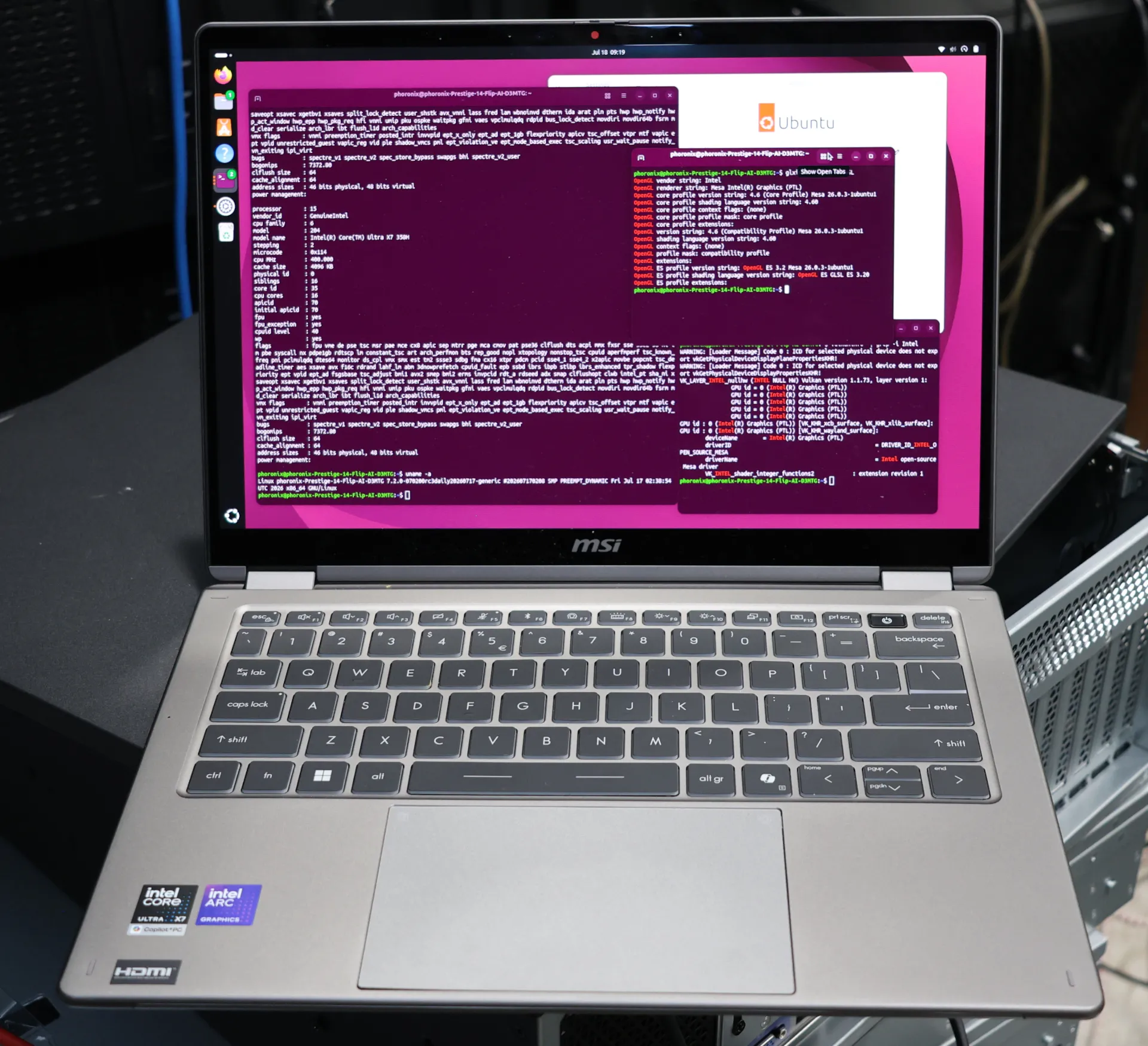
Linux 7.2 improves Panther Lake Xe3 graphics performance. Early testing of the kernel scheduled for stable release in August shows faster Arc B390 graphics on Intel Core Ultra Series 3 hardware, adding a practical performance gain alongside the release’s broader driver work.
NetworkManager 1.58 adds 464XLAT CLAT and GENEVE support. The release broadens Linux network-management capabilities for IPv4 connectivity over IPv6-only access networks and introduces management for GENEVE tunnel interfaces, alongside the usual wired and wireless refinements.
AMD is positioning SPIR-V as a portability layer for ROCm. Following ROCm 7.14’s first production release built from TheRock, AMD is highlighting unified SPIR-V binaries as a route to target multiple graphics architectures with less hardware-specific build complexity.
KNOD patches propose direct in-kernel network offload to AMD GPUs. The early Linux patch set drives GPU acceleration without depending on user-space libraries such as ROCm. If the design matures, it could create a low-level path for network workloads to reach GPU compute resources directly.
Trawl offers adaptive, self-hosted web scraping for UGREEN NAS systems. The open-source engine escalates requests through four levels—from lightweight HTTP to cached browsers, live challenge solving, and residential proxies—while aiming for sub-500ms repeat responses.
AI / ML

Kimi K3 puts another Chinese open-weight model in the spotlight. Moonshot AI’s release is drawing attention for its reported performance and open-weight approach, even earning public praise from Elon Musk. The launch reinforces how quickly Chinese labs are narrowing the visibility gap with leading US model makers.
Sony says Udio infringed more than 30,000 songs. A new lawsuit names works from Elvis Presley, Beyoncé, and Harry Styles and alleges that the disclosed list represents only a fraction of the catalogue used by the AI music generator. The filing follows discovery in the labels’ earlier litigation over training data. [The Verge]
Adobe’s “natural look” camera app is adding generative AI. Project Indigo’s experimental AI Playground introduces optional image-generation tools sourced beyond Adobe’s own Firefly family. The test is being offered to a small group without requiring sign-in, while users can opt out and retain the original camera workflow. [The Verge]
Working with Claude requires more than one-shot prompting. A practical guide distinguishes simply asking the assistant isolated questions from building an ongoing workflow that supplies context, refines outputs, and treats the model more like a collaborative analyst.
A historian argues that AI backlash is necessary. Jill Lepore frames large-scale data collection and automated measurement as systems that can flatten human concerns, connecting today’s AI debate to wider questions about institutions, governance, and technology’s political power. [The Verge]
An Australian council will trial AI-managed traffic lights. The pilot will test whether adaptive signals can respond to live traffic patterns more effectively than fixed timing, offering a real-world measure of whether machine-learning control can reduce congestion.
Security / CVE
GNOME is tightening its security-reporting policy after an influx of AI-generated submissions. The project is changing how it handles reports whose automated findings may be low quality or insufficiently validated, an increasingly common maintenance burden for open-source security teams.
QR-code fraud is becoming a mainstream threat in Portugal. “Quishing” attacks exploit the routine use of QR codes for payments, documents, and web access to conceal malicious destinations. Users should inspect the displayed URL before continuing and avoid scanning codes placed over legitimate signage.
The FCC is preparing to ban already-approved products linked to DJI. After proposing fines against companies selling Skyrover drones and Xtra cameras, the agency is moving toward retroactively revoking authorisation for devices it views as attempts to evade the US foreign-drone restrictions. [The Verge]
Hardware
Samsung’s reported GAIA accelerator could loosen Microsoft’s grip on the AI-PC definition. GAIA is described as a companion NPU rather than a full system-on-chip, built on a 4nm process and potentially paired with processing-in-memory DRAM. A viable independent accelerator would give PC makers another route to local AI features beyond the usual Intel, AMD, Qualcomm, and Nvidia platforms.
Intel is expanding memory support for Xeon 6 and Xeon 6+. Upcoming BIOS updates will broaden compatible RDIMM and MRDIMM configurations for current servers, giving customers more capacity and performance options while next-generation Diamond Rapids remains scheduled for next year.
The Ryzen 7 7700X3D’s $279 price hides a platform-cost problem. AMD’s eight-core gaming chip offers 96MB of 3D V-Cache and undercuts the 7800X3D, but elevated DDR5 memory prices can erase much of the apparent saving when budgeting a complete build.
Some LG monitors are silently bringing McAfee promotions to Windows. Connecting affected UltraGear models can prompt Windows Update to install LG’s Monitor App Installer without an explicit permission dialog; the utility then promotes LG software and McAfee through desktop pop-ups. [The Verge]
Ford’s $30,000 electric truck anchors a lower-cost EV reset. The company is developing a Universal Electric Vehicle Platform after ending the F-150 Lightning, with a smaller truck due to be revealed in 2027 and a wider affordable-EV family planned for Kentucky production. [The Verge]
Startups
SpaceX’s expected Nasdaq-100 entry raises questions for passive investors. Fast-tracking a highly valued and volatile company into a major index would automatically expose index-fund holders to it, illustrating how “passive” investing still depends on active index-composition decisions. [The Verge]
Archer and Anduril are taking electric air taxis into defence aviation. Their newly unveiled Thunder aircraft adapts electric vertical-takeoff technology for both military and commercial roles, showing how an industry built around urban mobility is seeking earlier revenue in defence markets. [The Verge]
In Brief
NASA has released a Psyche Mars-flyby timelapse. Thousands of images from the spacecraft’s passage have been assembled into a detailed view of the red planet as the mission continues toward its asteroid target.
A judge has temporarily paused Paramount’s Warner Bros. Discovery acquisition. A coalition of US states persuaded the court that the proposed $110 billion deal could cause irreparable competitive harm while its antitrust challenge proceeds. [The Verge]
The first proper Avengers: Doomsday trailer has arrived. Doctor Doom’s threat is set against tensions among the X-Men, Fantastic Four, and Avengers, with Thor trying to focus the factions on their shared enemy. [The Verge]
Christopher Nolan’s The Odyssey makes the case for IMAX presentation. A second viewing on the larger format reportedly clarified the scale and visual intent of sequences that felt less convincing in a conventional screening. [The Verge]
Portuguese students face a €25 fee per subject to request an exam re-evaluation. The charge applies when candidates challenge their national-exam grade and seek a formal review.
Saharan dust is becoming more concentrated over Portugal. An international study finds that the country is among the European areas most exposed to increasing desert-dust particles in the atmosphere.
Portuguese consumers are taking Spain’s grid operator to court over the April 2025 blackout. A consumer association is seeking compensation for losses attributed to Red Eléctrica de España.
UNESCO puts long-term Mediterranean tsunami risk at certainty. The assessment says at least one event is expected within the next 30 to 50 years, with Portugal also exposed to the wider regional hazard.
Roundup compiled from the TT-RSS Tech feed. 41 articles from 5 sources summarised across 41 story clusters.